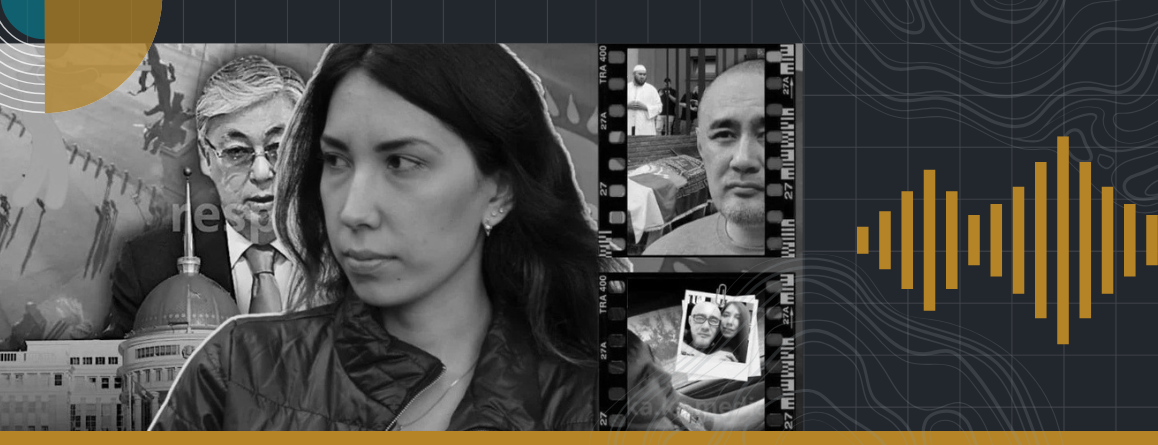
Freedom for Eurasia strongly condemns the defamation lawsuit brought by Gadzhi Gadzhiev against Natalia Sadykova before the courts of Ukraine — the country where Sadykova lives in exile and where her husband was assassinated.
Natalia Sadykova is a journalist, widow of Aidos Sadykov, and editor of the BASE YouTube channel, one of the most widely-followed independent Kazakh media outlets. Gadzhi Gadzhiev is a Dagestani businessman who built his fortune in Kazakhstan. He was publicly linked to the 2024 assassination of journalist Aidos Sadykov and in September 2025 was added to the Myrotvorets database, where he is listed in connection with allegations of involvement in sanctions-evasion operations, complicity in Russia’s hybrid aggression against Ukraine, organization and financing of a terrorist acts on the territory of Ukraine, and cooperation with Russian intelligence services.
The complaint targets Sadykova’s journalistic reporting on Gadzhiev’s alleged role in corruption and in the circumstances surrounding her husband’s murder. A first hearing took place in Kyiv on 22 April 2026 and was adjourned to June. Freedom for Eurasia regards this lawsuit as a Strategic Lawsuit Against Public Participation (SLAPP): a legally dressed act of persecution whose purpose is not to obtain a legitimate remedy, but to silence, exhaust, and intimidate a journalist who continues to report on those responsible for her husband’s death.
Who Is Natalia Sadykova and What Is BASE?
Natalia Sadykova is a Kazakhstani journalist and political refugee living and working in Kyiv, Ukraine. Together with her husband Aidos Sadykov, she co-founded BASE — a YouTube channel with over one million subscribers and nearly 100 million views — which has become a cornerstone of independent Kazakhstani journalism in exile. BASE has built its reputation on systematic investigative reporting into elite corruption in Kazakhstan, presenting evidence of abuse of power that domestic media — operating under heavy state censorship — cannot and does not publish.
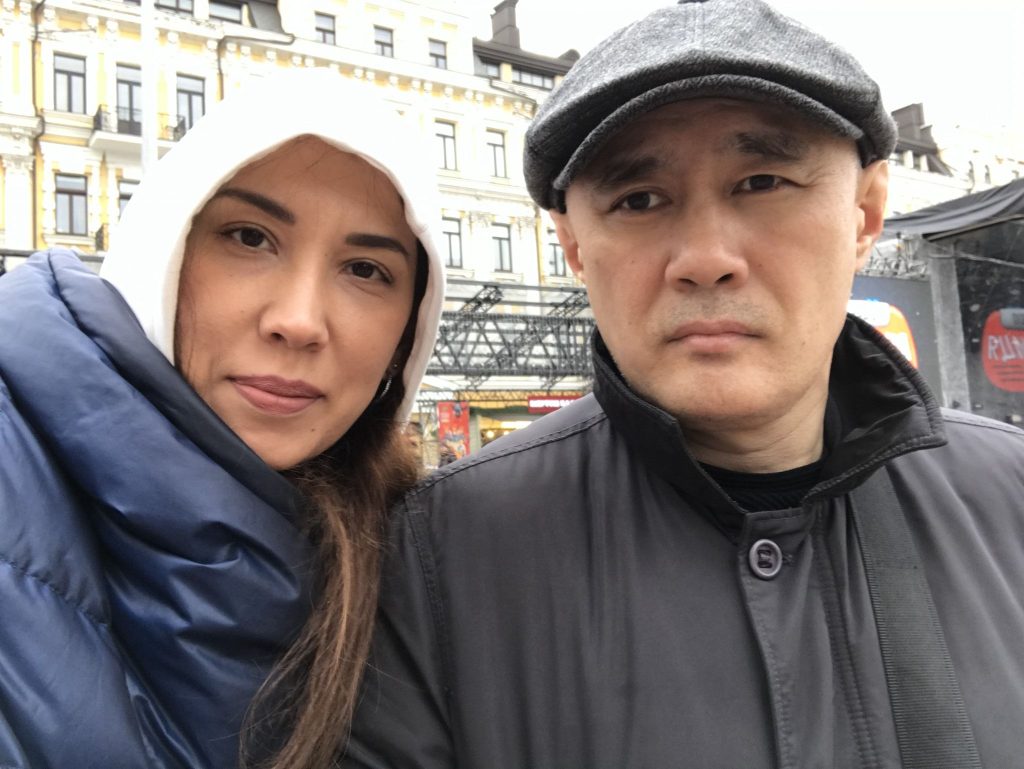
The Sadykovs left Kazakhstan in March 2014 after Natalia faced criminal prosecution for defamation, charges human rights defenders recognized as politically motivated. In Ukraine, they obtained refugee status and continued their work. Their independence and reach made them targets. In March 2023, Aidos Sadykov publicly disclosed that a man claiming to represent Gadzhiev had approached him in Kyiv offering $5,000 USD in exchange for the deletion of a BASE video about the businessman. Aidos refused.
On 18 June 2024, Aidos Sadykov was shot in broad daylight in Kyiv. He died in hospital on 2 July. Ukrainian investigators identified two Kazakh nationals — Altay Zhakanbayev and Meiram Karataev as the perpetrators. Zhakanbayev is linked to Kazakhstan’s Foreign Intelligence Service (SVR), while Karataev is a former police sniper with suspected ties to Kazakhstan’s National Security Committee (KNB). In July 2024, Zhakanbayev surrendered to the authorities in Kazakhstan and was released under a travel restriction order. Kazakhstan has refused all cooperation with the Ukrainian investigation, declined to question the identified suspects, and has not responded to Ukraine’s formal judicial assistance requests. Karataev is formally listed as a fugitive — Kazakhstani authorities claim publicly to be unable to locate him. Yet sources familiar with the situation report that he continues to use his bank cards and lives undisturbed on Kazakhstani territory. This renders the official account implausible and raises an unavoidable question: whether his “wanted” status constitutes a genuine law enforcement effort, or a convenient fiction that provides cover for a man whose ties to state structures appear to afford him effective immunity.
The Lawsuit as a Continuation of Persecution
Gadzhiev’s defamation complaint against Natalia Sadykova must be understood not in isolation but as one element in a documented pattern of transnational repression. Since the murder of her husband, Sadykova has faced:
- Surveillance by Kazakh state agents: In November 2025, Ukrainian police identified a man covertly filming Sadykova outside her home in Kyiv as Rustem Alibekovich Sarsembekov, a KNB officer operating under diplomatic cover. Sadykova’s lawyer publicly stated that such surveillance may indicate preparation for an attack.
- Sustained digital harassment: Sadykova has been subjected to multiple waves of phishing attacks targeting her personal accounts, including operations linked by cybersecurity firm Sekoia.io to Void Balaur, a cyber-mercenary group with suspected ties to Russian state intelligence.
- Intimidation via messaging applications: She has received threatening communications from numbers based in Kazakhstan and Russia, including one using the logo of Kazakhstan’s Interior Ministry as its profile picture.
- Obstruction of justice: Kazakhstan’s refusal to cooperate with the murder investigation — including its refusal to question its own nationals identified as suspects — has ensured that the killers of Aidos Sadykov remain free.
The defamation lawsuit is the latest instrument in this arsenal. Gadzhiev’s complaint covers reporting directly related to questions Ukrainian investigators are pursuing — namely, his alleged connection to the individuals who arranged the murder of Aidos Sadykov. Using civil litigation to punish a journalist for coverage that is the subject of an active criminal investigation represents a dangerous and deliberate conflation of legal process and suppression.
The hallmarks of a SLAPP are present and unmistakable:
- The complainant is a subject of the journalist’s reporting and is publicly linked by the journalist and by Ukrainian investigators to the assassination of her husband.
- The legal claims rest on reputational allegations that target the substance of journalistic investigation into matters of serious public interest.
- The objective effect — regardless of outcome — is to impose legal costs, psychological pressure, and reputational risk on a journalist already operating under conditions of acute physical danger.
- The lawsuit follows a pattern of escalating coercive measures, from attempted bribery to assassination to surveillance to now formal litigation.
Transnational Repression Through the Courts
This case is a textbook instance of transnational repression — the use of mechanisms available in democratic legal systems to continue the persecution of exiled journalists and dissidents. When a state or its proxies cannot silence a journalist through threats alone, they turn to courts. The legal process itself becomes the punishment: endless hearings, mounting legal bills, and the existential weight of litigation that no journalist in exile can easily afford to defend.
When legal proceedings are initiated by individuals closely linked to an unsolved political assassination — and when those proceedings target reporting directly relevant to that assassination — the judicial system of the host country is being weaponized against the very journalist it has a duty to protect. Ukraine has demonstrated its willingness to investigate the murder of Aidos Sadykov. It must now demonstrate equal commitment to preventing its civil courts from being used as instruments of the same repression that produced that murder.
Freedom for Eurasia Demands
- The immediate dismissal of the defamation complaint filed by Gadzhi Gadzhiev against Natalia Sadykova. Ukrainian courts must conduct a rigorous early-stage assessment of its abusive character — scrutinizing the complainant’s background and alleged prior attempt to suppress BASE reporting through payment, and allegations of his connection to the murder of Aidos Sadykov — and dismiss it on the grounds that it constitutes a SLAPP targeting a journalist for reporting of clear public interest.
- That Gadzhi Gadzhiev be immediately removed from his position as Vice President of the National Olympic Committee of Kazakhstan. An individual currently under investigation by Ukrainian law enforcement in connection to the assassination of a journalist, who has mounted a defamation lawsuit against that journalist’s widow who herself is a journalist for her continued reporting, has no place in a position of public trust or international institutional representation. His continued tenure at the NOC affords him the reputational cover and access of a quasi-diplomatic post — including privileged entry to international institutions, sporting bodies, and government interlocutors — which functions as laundering of a profile that should instead be subject to scrutiny and sanction. Freedom for Eurasia further demands that Gadzhiev be investigated for his alleged role in sanctions evasion operations, and should his involvement be confirmed then his removal from the NOC be accompanied by referral to relevant European and international authorities for the purpose of asset tracing, travel bans, and targeted sanctions designation.
- Robust protective measures for Natalia Sadykova and her children in Ukraine, commensurate with the documented threat to her life from state and non-state actors connected to Kazakhstan.
- Urgent attention from European institutions, press freedom organizations, and international human rights bodies to this case as an instance of transnational repression through legal means.
- Full cooperation by Kazakhstan with the Ukrainian criminal investigation into the assassination of Aidos Sadykov, including the questioning and extradition of identified suspects.
Aidos Sadykov was killed for his journalism. His wife Natalia Sadykova continues that journalism, at great personal cost and under constant threat. The attempt to now use the courts of the country in which she sought refuge to punish her for doing so is not a legal matter — it is a political one. Freedom for Eurasia will not allow it to pass without record and without condemnation.
Freedom for Eurasia stands in full and unconditional solidarity with Natalia Sadykova.
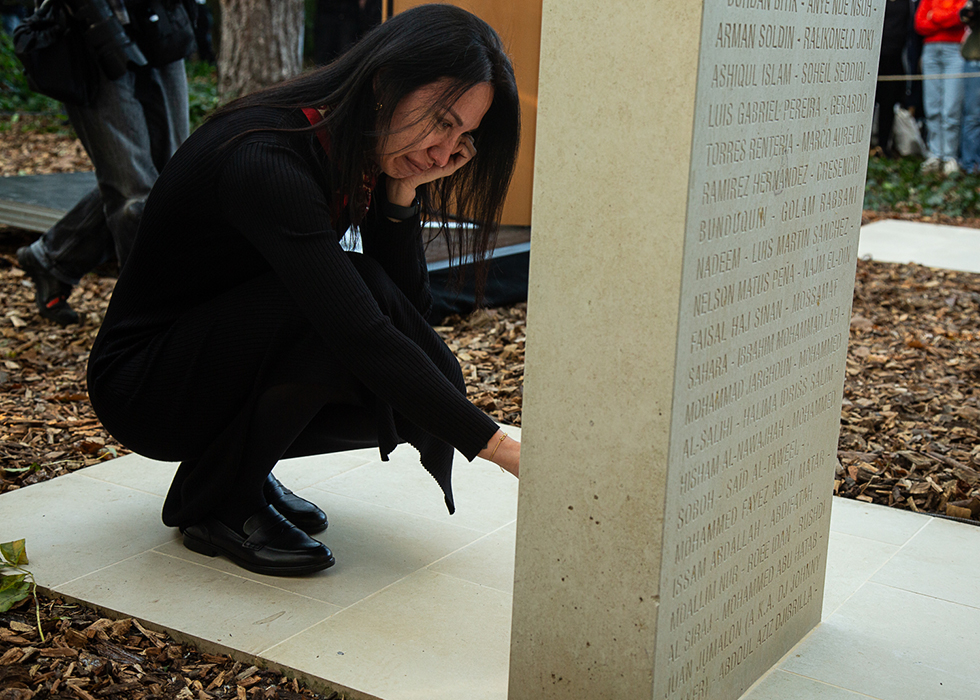
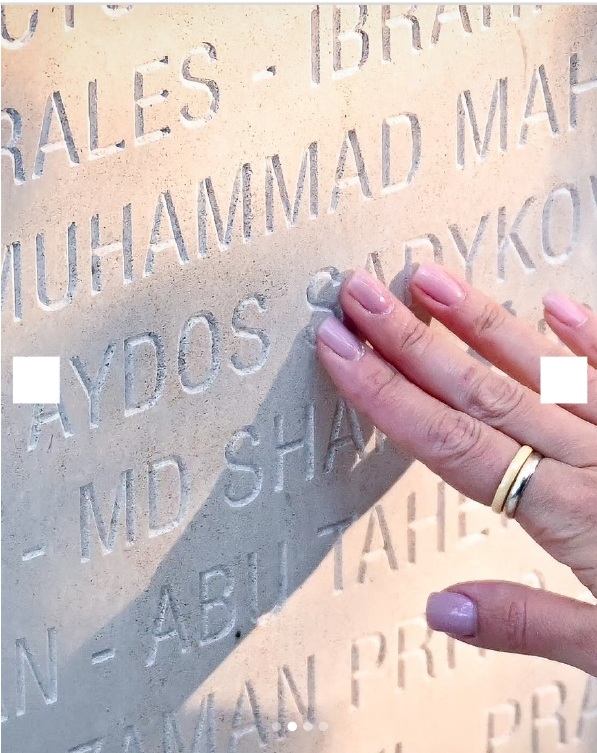
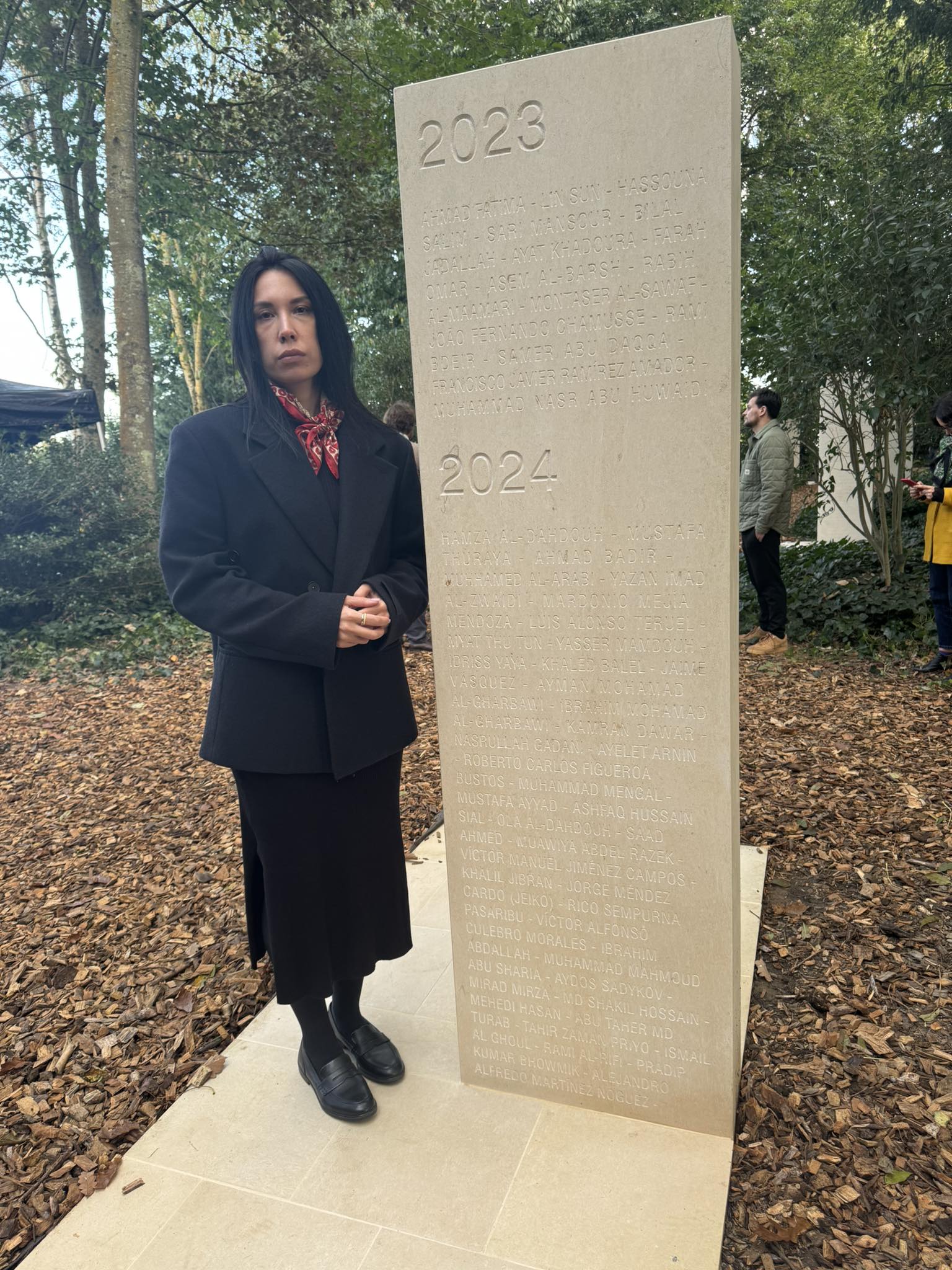
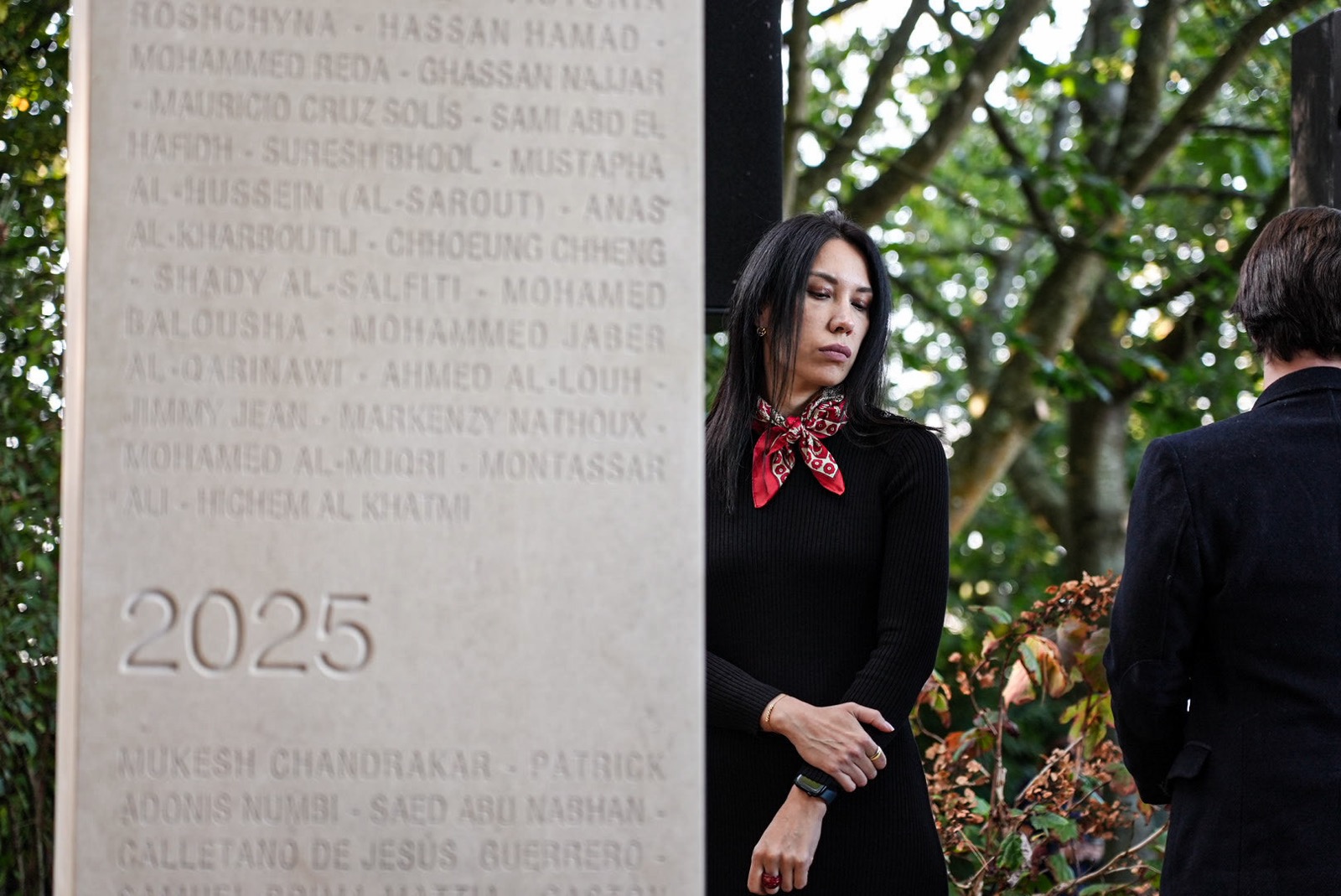
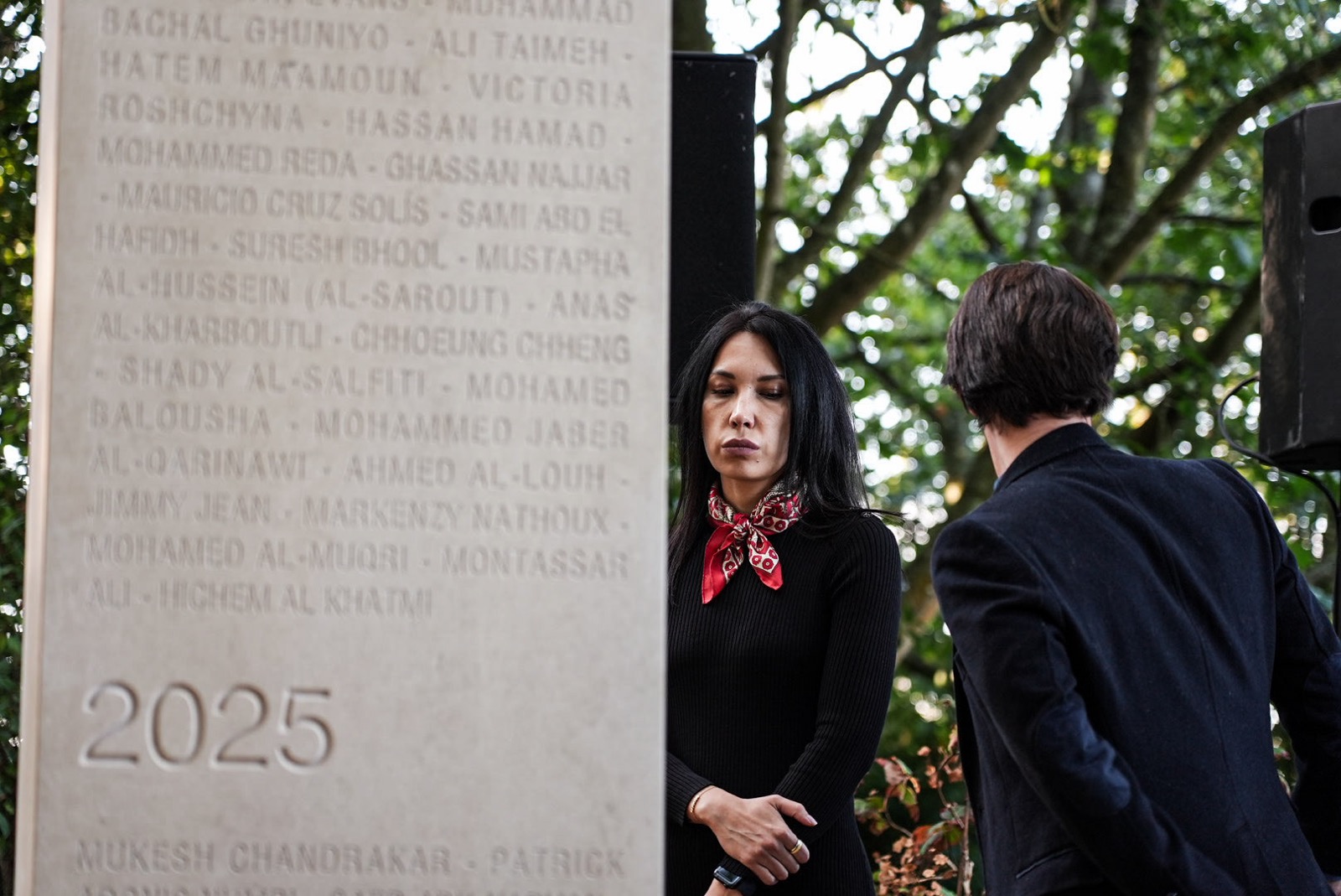
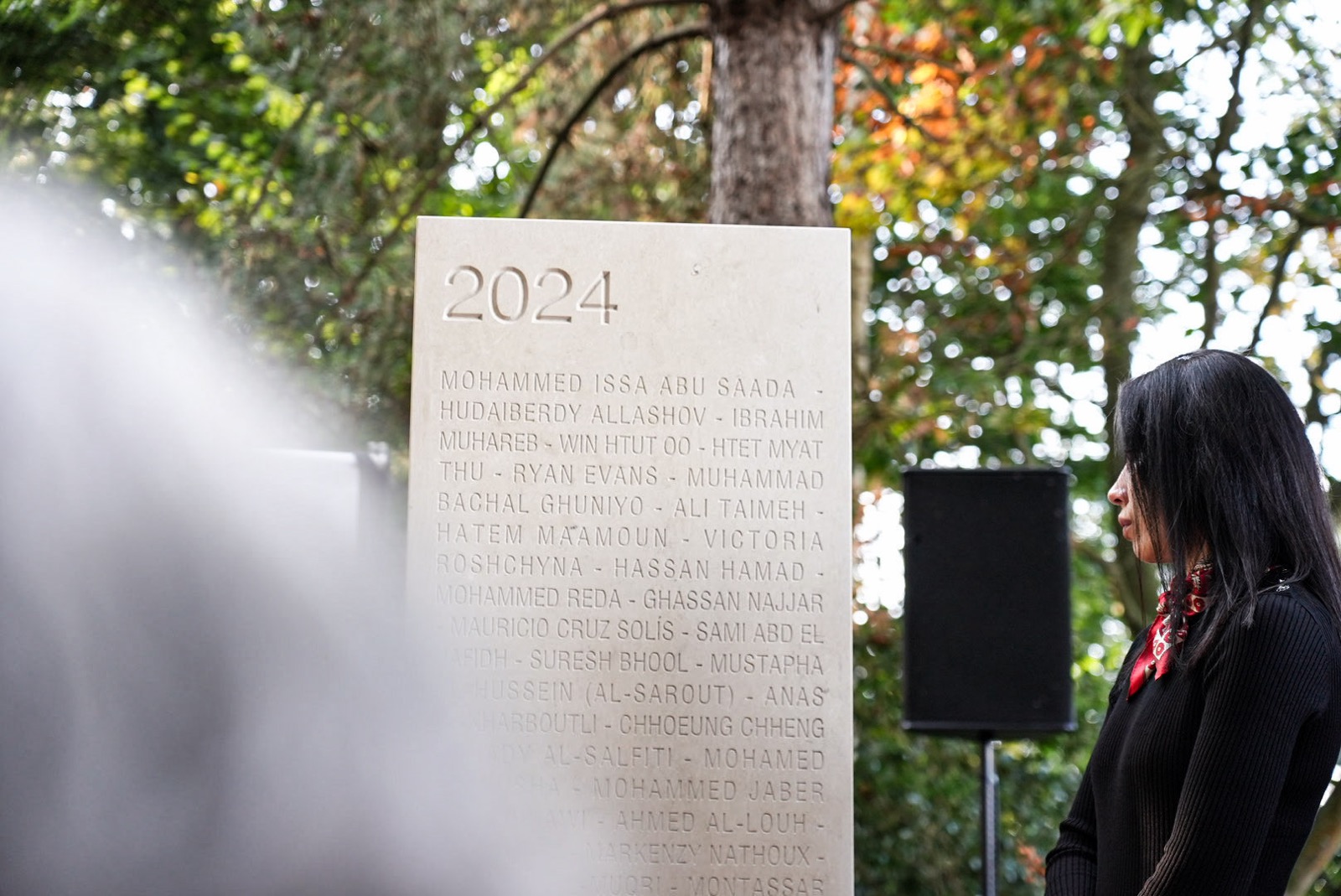
Natalia Sadykova at Bayeux-memorial. Photo by Thomas Haley
On 9 October 2025, Thibaut Bruttin of Reporters Without Borders unveiled the Bayeux Reporters’ Memorial stele in the presence of the families of 73 journalists killed in the line of duty between 1 June 2024 and 1 June 2025 — among them Aidos Sadykov, whose name now stands engraved alongside those of his colleagues as a permanent testament to the price he paid for independent journalism.