
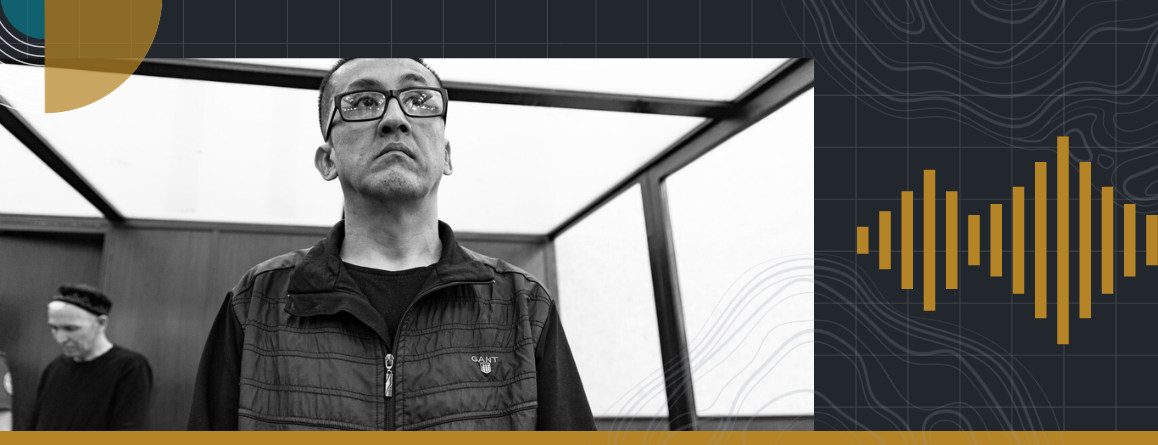
Freedom for Eurasia expresses serious concern over new violations of fair trial guarantees in the case of Karakalpak political prisoner, journalist, and lawyer Dauletmurat Tajimuratov, following the court hearing held on 10 April 2026 in Navoi.
A video has been published featuring his brother, Rinat Tajimuratov, in which he provides a first-hand account of being unlawfully denied access to the hearing despite prior authorization reportedly granted by the presiding judge. According to his testimony, he was invited by a state-appointed lawyer to attend the proceedings, but upon arrival at Correctional Facility No. 11, he was refused entry on the pretext that he needed to undergo identity verification elsewhere—an explanation that appears arbitrary and unfounded.
As described in the video, the hearing itself was conducted in a summary manner: all defense motions were denied, witnesses were not examined, and the session was rapidly concluded and postponed without disclosure of the next hearing date. Furthermore, Mr. Tajimuratov’s brother reported that he was unable to obtain information about future visits or deliver essential items, indicating broader restrictions on family contact.
Additional information raises even more serious concerns. During the proceedings, officials reportedly “requested” that the state-appointed lawyer not inform Mr. Tajimuratov about his brother’s arrival. Such conduct, if confirmed, constitutes direct interference with the right to defense and undermines the principles of equality of arms and effective legal representation.
The lack of transparency is further evidenced by the fact that information about the hearing appeared on the website of the Supreme Court of Uzbekistan only after the session had concluded, contrary to standard practice. This suggests deliberate efforts to restrict public scrutiny of the proceedings.
Reportedly the next hearing in this new criminal case is scheduled for 17 April 2026 at 10:30.
These developments take place in the context of a new criminal case brought under Article 220 of the Criminal Code of Uzbekistan (“disorganization of the work of correctional institutions”), which could result in an additional sentence of 5 to 10 years. If imposed, this would increase Mr. Tajimuratov’s total sentence from 16 to as much as 25 years of imprisonment.
Freedom for Eurasia recalls that Mr. Tajimuratov was convicted following the July 2022 events in Karakalpakstan, where protests were violently suppressed by state authorities, resulting in significant loss of life. While official figures reported 21 victims, independent human rights defenders estimate that the number of victims may range from dozens to several hundred. Since his detention, consistent reports from his lawyer and family have pointed to systematic torture, ill-treatment, and ongoing harassment.
The exclusion of a close family member from the hearing, the failure to ensure adversarial proceedings, the reported interference with defense counsel, and the broader pattern of opacity surrounding this case raise serious concerns under international human rights law, including the right to a fair and public hearing and the absolute prohibition of torture and ill-treatment.
Freedom for Eurasia calls on the authorities of Uzbekistan to:
- Ensure full compliance with fair trial standards, including public access to hearings and the participation of family members;
- Guarantee the independence of the legal profession and refrain from any interference with defense counsel;
- Promptly and impartially investigate all allegations of torture and ill-treatment;
- Ensure transparency in judicial proceedings, including timely public notification of hearings;
- Drop the new charges if they are retaliatory in nature and ensure that Mr. Tajimuratov’s rights are fully respected.
Freedom for Eurasia will continue to closely monitor the situation and remains engaged with international partners to ensure accountability and protection of fundamental rights in this case.