
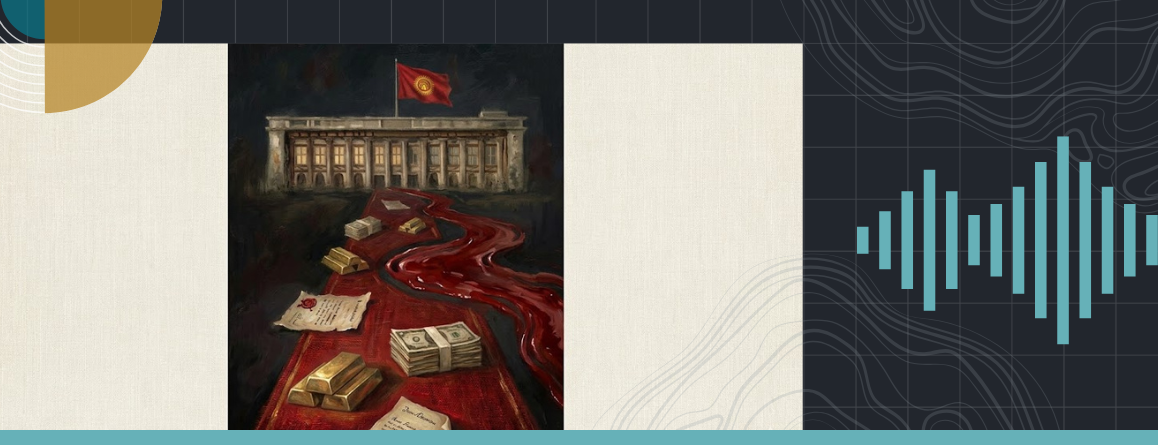
Eleven years ago, Global Witness published “Blood Red Carpet,” an investigation into how Maxim Bakiyev, son of ousted Kyrgyz president Kurmanbek Bakiyev, bought a £3.5 million mansion in Surrey through an anonymous Belize-registered company, Limium Partners Limited, just two months after arriving in the UK and claiming asylum. The report showed how a system of “gatekeepers” — lawyers, real estate agents, and offshore company formation agents — failed, or declined, to establish the origin of the money belonging to a man wanted internationally by Interpol on charges of embezzling state funds and ordering the attempted murder of a British national.
This report is not an archival curiosity. It describes a mechanism that still shapes what happens to the billions in assets moved out of Kyrgyzstan in 2010 — and it is directly relevant to what is unfolding around the Bakiyev clan right now.
Why This Matters Now
Over the past two to three years, the question of the Bakiyevs’ return to Kyrgyzstan has moved from abstract speculation to an active political agenda. Several developments confirm this:
- In February 2023, President Sadyr Japarov held a meeting in Dubai with all of Kyrgyzstan’s former presidents — including Kurmanbek Bakiyev, who was convicted in absentia and remains wanted — a meeting that provoked a mixed public reaction.
- Kyrgyzstan’s Constitutional Court has allowed a review of Kurmanbek Bakiyev’s criminal cases, on condition that he returns to the country in person.
- Belarusian president Alexander Lukashenko has publicly stated that Bakiyev wants to come to Kyrgyzstan, if only to visit his father’s grave, and that the matter will be resolved with the current Kyrgyz leadership.
- At the same time, there is talk of a possible return of Bakiyev’s son Maxim and his brother Zhanysh — both sentenced to life imprisonment for embezzlement and corruption — with officials stressing that they would be arrested immediately upon arrival.
- Unconfirmed rumors periodically surface, and are officially denied, that Maxim Bakiyev has already secretly flown into Bishkek.
- In parallel, there is discussion of recovering part of the roughly $200 million allegedly siphoned out of the country by Maxim Bakiyev — precisely the kind of funds whose origin Global Witness tried to trace back in 2015.
In other words, the question at the heart of “Blood Red Carpet” — where the money went and who was hiding it — is once again at the center of a political bargain. Talk of “reconciliation,” “rehabilitation,” and a voluntary Bakiyev return inevitably circles back to what the report established: a substantial share of the funds stolen from the Kyrgyz people ended up as property and offshore structures in the West, rather than being returned to the state.
What the Report Shows — and Why It Remains Unresolved
Global Witness’s report documented:
- The Surrey mansion was bought without a mortgage by an anonymous offshore company registered in Belize just 15 days before the purchase — through the same Belizean company formation agent and at the same address as companies implicated in schemes that moved roughly $30 million out of Kyrgyzstan around the time the Bakiyev regime fell.
- The law firm and estate agent involved in the transaction declined to disclose details of their client due diligence, citing confidentiality and legal privilege — even though the buyer was already the subject of an Interpol Red Notice at the time of the purchase.
- Even after Limium Partners was wound up “for non-payment of government fees,” the mansion remained legally registered in its name — a textbook example of how an offshore vehicle can be created for a single transaction and then effectively disappear, leaving investigators with no thread to follow.
That opacity — the practical impossibility of establishing a property’s true beneficial owner — is precisely the infrastructure that continues to let elites from post-Soviet authoritarian regimes shield stolen assets while simultaneously negotiating the terms of their own “return” home.
Why This Report Deserves Renewed Attention Today
While Bishkek debates the shape a Bakiyev return might take — an open trial, “reconciliation for the sake of unity,” early release — the question of where the assets actually are remains at the margins of the public conversation. “Blood Red Carpet” is a reminder: without an answer to where the money that left the country ended up, and who actually controls it now, any political settlement involving the Bakiyevs will remain incomplete. The 2015 report is not simply a story about a Surrey mansion — it is a map of how stolen-asset protection is built, and its findings should inform any conversation about the terms on which Kyrgyz society is prepared to accept the return of people its own courts have held responsible for the embezzlement and violence of April 2010.
Source report: Global Witness, “Blood Red Carpet,” March 2015.