A refugee in Vienna, a manufactured terrorism case, and a precedent Austria should not ignore.
By Leila Nazgul Seiitbek
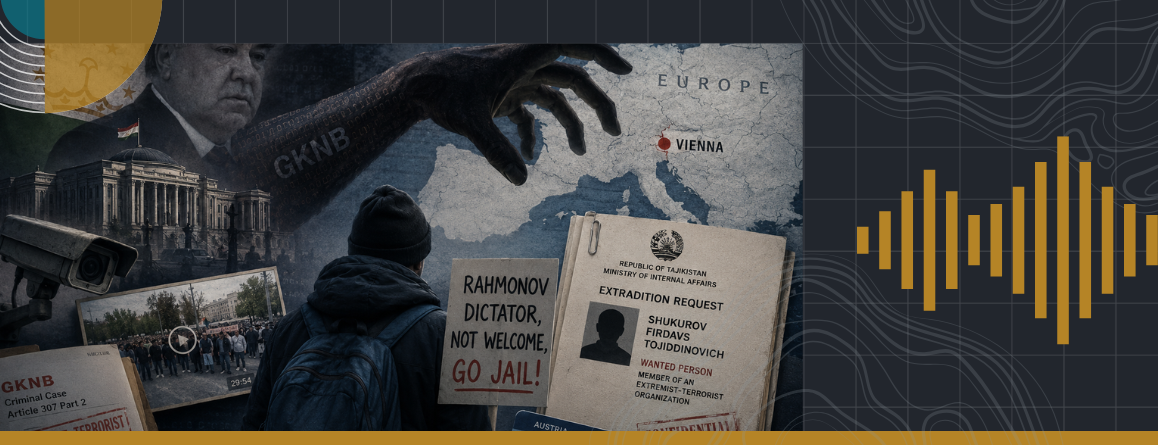
In April 2026, the Austrian Federal Ministry for European and International Affairs forwarded to the Ministry of Justice a letter from the Tajik Interior Ministry. It was not a diplomatic note. It was a dossier formally titled “Procedural Materials Regarding the Extradition of the Citizen of the Republic of Tajikistan, Wanted Person, Shukurov Firdavs Tojiddinovich – Member of an Extremist-Terrorist Organization.”
The cover letter, signed in Vienna on April 24, informed the Austrian Justice Ministry that Dushanbe had transmitted files on not one but 18 individuals who, in the words of the Tajik Interior Ministry’s own letter, “have sought refuge on the territory of the Republic of Austria.”
That phrase – “have sought refuge” – should give European governments pause. Dushanbe is not merely asserting that it knows where these 18 people live. It is acknowledging, in its own request for their extradition as alleged terrorists, that they fled to Austria as refugees. The 18 individuals named in the request are alleged members of organizations Tajikistan has designated as extremist and terrorist: Group 24, Salafiya, the Islamic Renaissance Party of Tajikistan (IRPT), and the National Alliance of Tajikistan. Austria itself has not made such designations.
How Tajikistan’s Interior Ministry came to track a refugee in Austria so precisely is the real story here, and it is far more sinister than a routine diplomatic exchange suggests.
A Request Built on Surveillance, Not Investigation
The Tajik Ministry of Internal Affairs submitted its extradition package for Firdavs Shukurov under Article 307 Part 2 of the Tajik Criminal Code – a provision covering membership in extremist-terrorist organizations. The charges were drafted by a senior investigator of the GKNB, Tajikistan’s secret police, and Shukurov was declared wanted in absentia on February 17, 2022. The Tajik court ordered his detention for two months, with no defense counsel present, no notification of the accused, and no date filled in on the order. The resolution read, literally: “This Resolution was announced to me on __ 20__ at ___ hours ___ minutes.” Tajikistan produced legal documentation of a hearing that appears to have never taken place, for a man it simultaneously acknowledged it could not find, and sent that documentation to Austria as the basis for his extradition.
The underlying “evidence” is just as thin.
The GKNB’s own resolution opening the criminal case, dated January 10, 2022, stated the charge plainly: on October 13, 2021, Shukurov “participated in a protest demonstration in the city of Vienna, Republic of Austria,” where he “held a banner containing the following slogan: “RAHMONOV DICTATOR, NOT WELCOME, GO JAIL!’”
Investigators further noted that on October 26, 2021, “during monitoring of the YouTube social network,” they discovered and seized a video of the demonstration, running 29 minutes and 54 seconds. An “expert opinion” from Tajikistan’s own Center for Strategic Studies – a body under the direct authority of the president whose visit was being protested – then concluded that holding this banner constituted “participation in and assistance to the activities” of a banned extremist-terrorist organization.
That is the entirety of the conduct underlying the terrorism charge Austria is being asked to enforce through extradition: a protest sign and a YouTube video, surveilled, transcribed, and criminalized by the security services of the government the sign criticized. There is no allegation of violence, no weapons, no plot – only speech, captured on camera in a European capital and prosecuted as terrorism 4,000 kilometers away.
How Dushanbe Found Him
The dossier arrived in Vienna not through the standard Interpol Red Notice mechanism – in which Interpol’s General Secretariat vets a request before member states act on it – but through a direct bilateral channel. Tajikistan’s Interior Minister wrote personally to Austria’s Justice Minister on April 10 of this year; the letter was stamped received in Vienna on April 22, with the Foreign Ministry formally relaying it two days later.
This is a deliberate tactical shift. Tajikistan has traditionally weaponized Interpol itself. According to an analysis of leaked Interpol files published by the BBC World Service and Disclose earlier this year, Tajikistan ranked third in the world by number of active Red Notices as of September 2024, with 3,493 – trailing only Russia and Peru. Going directly to a host government, dossier already in hand, sidesteps even that minimal multilateral filter.
Shukurov holds an Austrian asylum entitlement – a blue residence card issued by the Federal Office for Immigration and Asylum – and appears to have resided in Austria since at least 2017. His address, asylum status, and registration data are all visible in the Austrian Melderegister; Dushanbe needed no Interpol notice and no remarkable feat of research to find him. What it needed was a reason to go looking, and that came from elsewhere. Tajikistan’s GKNB maintains a documented network of agents embedded in diaspora communities across Germany, Austria, Poland, and Sweden, who attend community gatherings, photograph protesters, and report political activity back to Dushanbe. A self-described former GKNB operative, in a detailed confession to Eurasianet in 2019, described his task as simply “to collect information” on exiled opposition figures – surveillance that has, in at least one documented case, extended to an alleged assassination plot.
The Austrian Foreign Ministry’s own transmission letter conceded that “it cannot be excluded that the person is being politically persecuted due to their membership in opposition and government-critical movements.” But it forwarded the dossier to the Staatsanwaltschaft Wien, the Vienna Public Prosecutor’s Office, regardless.
Europe Must Not Be Dushanbe’s Arm
In March 2020, Austria extradited Hizbullo Shovalizoda, a Tajik asylum seeker in Vienna, directly to Dushanbe; he was arrested on the tarmac and, four months later, sentenced to 20 years in a secret trial his family was barred from attending. The Austrian Supreme Court subsequently ruled the extradition illegal, finding that Vienna’s rejection of his asylum claim had relied on outdated country information – a vindication that arrived only after the harm was done.
Tajik nationals deported from Germany and Poland in recent years have received sentences ranging from seven to 23 years, in proceedings where, as one former detainee on a Tajik extradition request put it, “the absence of a criminal case doesn’t mean that they are immune from persecution.” The case, in other words, can be manufactured on arrival.
There is a particular cruelty in what Tajikistan is doing here: destroying civil society at home, driving people into exile, then following them into exile – photographing them at legal demonstrations, mapping their addresses through informant networks, and filing paperwork designed to pull them back into a system where a 20-year sentence awaits anyone the GKNB labels a terrorist.
An Austrian justice system that processes such a dossier like that related to Shukurov – even to the stage of preliminary review – lends its legal infrastructure to that purpose, one its own Foreign Ministry has already flagged as potentially illegitimate.
The Shukurov dossier should not proceed any further. It should be returned, with a clear statement that Austria does not extradite individuals to a state where torture is systematic, where opposition membership is criminalized, and where the requesting government’s own correspondence acknowledges the possibility of political persecution. The Shovalizoda case already established, at the highest level of Austrian courts, that extraditions to Tajikistan are illegal under current conditions. That ruling should function as a precedent, not a footnote.
Dushanbe’s long arm is reaching into Europe. Europe must decide whether to extend it – or cut it off.Authors
Original in the Diplomat
Leila Nazgul Seiitbek is chair of Freedom for Eurasia (FFE), a Vienna-based NGO documenting human rights abuses, corruption, and authoritarianism in Central Asia and the post-Soviet space.